
International
Chess Federation


CONTENTS Handbook
Approved by FIDE Council on 11/12/2025
Applied from 01/03/2026
1. Introduction
1.1 Accepted chess equipment is indispensable to the smooth operation and competitive integrity of modern tournaments, ensuring uniform performance, accuracy, and strict adherence to FIDE’s technical standards.
1.2 Complementary to the FIDE Handbook, the FIDE Technical Commission (TEC) has compiled the [TEC Online Forms](https://www.cognitoforms.com/FIDE/TECMenu) containing comprehensive information, including definitions, processes, and clarifications essential for understanding and implementing FIDE's technical regulations.
2. Definitions and Acronyms
Refer to General Regulations under Chess Equipment Technical Specifications, Rules and Regulations.
3. Boards
3.1 Materials and Construction
3.1.1 Boards must be rigid and perfectly planar, constructed from natural wood such as birch, maple, or European ash combined with walnut, teak, or beech.
3.1.2 Boards should be water-resistant, at least briefly, to protect against accidental spills or moisture exposure.
3.2 Appearance and Finish
3.2.1 The board must present sufficient contrast between the “light” (e.g., white, cream, ivory, or buff) and “dark” (e.g., brown, walnut tone) squares. The contrast must be clearly recognisable by colour-blind individuals.
3.2.2 Squares must be distinguishable under normal lighting conditions from a viewing distance of approximately two meters.
3.2.3 The board’s surface finish must be opaque, matte, or otherwise non-reflective to prevent glare.
3.2.4 The overall appearance should be aesthetically pleasing and employ non-aggressive, natural colours.
3.3 Dimensions and Suitability
3.3.1 Each square on the board shall be the same in size and should measure between 5 and 6 centimetres per side.
3.3.2 Four pawns must fit comfortably on a single square.
3.3.3 The board’s weight should be suitable for stable placement and comfortable handling, ensuring it does not shift or tip easily when moved.
3.4 Underside and Stability
3.4.1 The underside of the board should feature felt pads or another form of skid-proof surface to enhance stability and reduce noise or slippage on the playing surface.
3.5 Special Requirements
3.5.1 For additional specifications for disabled players, see also Handicapped Players under Miscellaneous and other relevant FIDE regulations.
4. Mechanical Chess Clocks
4.1 Mechanical clocks must feature a “flag” or device that clearly indicates when a full hour has elapsed.
4.2 The clock must have a non-glare surface to facilitate easy time monitoring.
4.3 Clock levers and buttons must operate quietly, not exceeding 40 dB at a distance of 1 meter during normal operation.
4.4 The same model of chess clock should be used throughout the entire tournament, with the following exceptions:
4.4.1 Visually impaired players may use special clocks designed in compliance with rules in Handicapped Players under Miscellaneous.
4.4.2 If electronic boards are employed and require a different type of chess clock than those used on standard boards.
5. Paper Scoresheets
5.1 Paper scoresheets must include space to insert the following information:
5.1.1 Name of the competition
5.1.2 Round number
5.1.3 Table (board) number
5.1.4 Date of the round
5.1.5 Name of the White player
5.1.6 Name of the Black player
5.1.7 Result of the game
5.1.8 Signatures of both players and the arbiter
5.1.9 The number of the move and both White and Black moves.
5.2 Paper scoresheets must contain carbon copies.
6. Pieces
6.1 Materials and Style
6.1.1 Chess pieces should be of the Staunton style and crafted from wood, plastic, or materials closely imitating these substances.
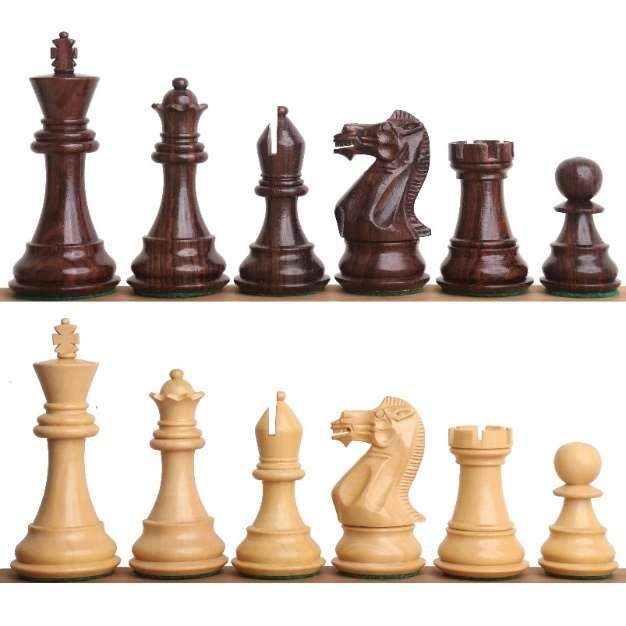
6.1.2 The “white” set may be white, cream, or other light shades, and the “black” set may be brown, black, or other dark shades (including natural wood tones such as maple or walnut). A clear contrast between the sets must be maintained.
6.1.3 Pieces should have pleasing, non-aggressive colours and a non-reflective, matte, or opaque finish that does not excessively shine.
6.1.4 Pieces should be designed with overall aesthetics, stability, and ease of handling in mind, ensuring they are neither top-heavy nor awkward to move.
6.2 Recognisability and Distinguishability
6.2.1 Pieces must be clearly distinguishable as “white” and “black” even to colour-blind individuals.
6.2.2 All pieces should be easily recognisable immediately from a normal viewing distance of approximately two meters.
6.2.3 The King’s top must be clearly different from the Queen’s top.
6.2.4 The Bishop’s top must be clearly different from the Pawn’s top, potentially featuring a notch or contrasting element to ensure no confusion between these pieces.
6.3 Size and Proportions
6.3.1 The correct height order of pieces is King > Queen > Bishop > Knight > Rook > Pawn.
6.3.2 Standard heights (with up to 10% variance allowed, if relative order is maintained) are:
6.3.3 The base diameter of each piece should be between 40% and 50% of its total height.
6.3.4 Pieces should appear balanced and well proportioned, ensuring they look and feel stable.
6.4 Stability and Handling
6.4.1 Pieces must remain stable on the board, capable of withstanding a tilt of approximately 30° without toppling.
6.4.2 Each piece should have a suitable weight for comfortable movement and secure placement on the board.
6.4.3 Undersides of pieces should be fitted with felt pads or a similar silent, skid-proof material to ensure smooth and quiet movement on the board.
7. Tables and Chairs
7.1 For all competitions organised under the aegis of EVE and GSC:
7.1.1 The length of the table should be approximately 110 cm, with a permissible variance of ±15%.
7.1.2 The width of the table should be approximately 85 cm, with a permissible variance of ±15%.
7.1.3 The height of the table should be 74 cm, with a permissible variance of ±10%.
7.2 For Junior, Youth, Cadet, and School competitions organised under EVE’s aegis, the table’s dimensions (length, width, and height) may be adjusted as appropriate to the ages of the participants, subject to EVE’s approval.
7.3 Chairs provided should be comfortable and produce minimal noise when moved, ensuring no disturbance to the players.
7.4 Tables and chairs must be stable and exempt from oscillations.
7.5 Tables and chairs must be of good quality and free from visible and hidden defects.
01. Non-Elected Commissions
02. Financial Regulations
03. Electoral Rules
08. FIDE Ethics
01. International Title Regulations (Qualification Commission)
Table for Direct Titles
02. FIDE Rating Regulations (Qualification Commission)
03. Regulations on Registration & Licensing of Players
04. Registration, Transfer & Rules of Eligibility for Player
06. Regulations for the Titles of Arbiters
B.06.4 – Regulations for the Appointment of Arbiters in World Events effective from 10 November 2025
07. Regulations for the Titles of Trainers / FIDE Endorsed Academies
08. Regulations for Accreditation in Chess in Education
09. Regulations on Seminars & Title Award for Organizers
11. FIDE Online Arena Regulations
C.02. Chess Equipment Technical Specifications, Rules, and Regulations
04. FIDE Swiss Rules
C.04.1 Basic rules for Swiss Systems
C.04.2 General handling rules for Swiss Tournaments
C.04.3 FIDE (Dutch) System
C.04.4 Other FIDE-approved Pairing Systems
C.04.6 Swiss Team Pairing System
C.04.7 FIDE-approved Accelerated Systems
07. Play-Off and Tie-Break Regulations
08. FIDE Chess Calendar
01. FIDE Individual World Championship Cycles
02. Chess Olympiad
02. Olympiad Pairing Rules
03. Cycle for Competitions for Men`s and Women`s National Teams
04. Other FIDE Competitions
01. General Regulations for FIDE Competitions
14. Bids Evaluation Criteria
19. FIDE World Corporate Chess Championship
07. Regulations for the FIDE World Rapid & Blitz Championships
01. Laws of Chess